Before
Enquiries, project plans, timesheets and invoices sat in separate spreadsheets and a standalone accounting package across two offices. Month-end close ran to about eleven days, and a project's margin stayed unknown until the work was over.
How Codelattice, working as Build to Sustain's Zoho ERP partner, joined projects, billing and finance across two offices into one system.
Enquiries, project plans, timesheets and invoices sat in separate spreadsheets and a standalone accounting package across two offices. Month-end close ran to about eleven days, and a project's margin stayed unknown until the work was over.
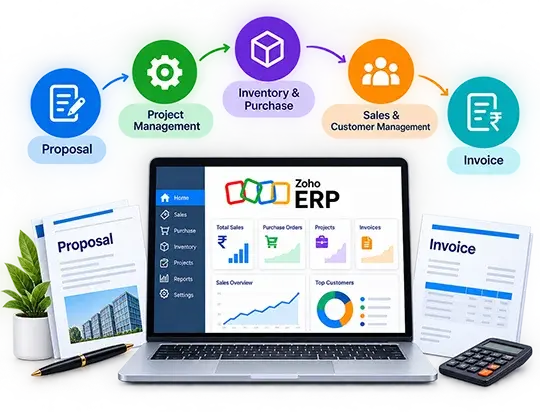
Each engagement now travels through one Zoho ERP, from CRM proposal to project delivery, timesheets, expenses and invoicing, with margin dashboards that leadership can open at any point in the month.
6 Zoho apps · 48 users · 14 automated workflows · 4 tool integrations · 3 billing models · 2 offices on one system
Build to Sustain advises manufacturers and exporters on ESG reporting, carbon accounting and supplier ratings, with consultants split between Bangalore and Kerala. Growth had been quick: more than 30 clients and 50 completed assessments. The business behind the work had not kept pace. Sales, delivery and finance each ran on their own tools, and joining them took people, not software.
That gap mattered more as the service mix widened. Eight service lines meant three different billing patterns: fixed-fee assessments, milestone-based reporting and monthly retainers for sustainability officer support. Each needed its own tracking in a spreadsheet, and the finance team rebuilt the picture by hand every month. The founders wanted to know which engagements earned their keep, but the numbers arrived after the fact. Codelattice was asked to replace that patchwork with a single Zoho ERP, and to do it without slowing down consultants who were already stretched across client sites and audit deadlines.
Five problems stood in the way:
Disconnected systems. Proposals lived in email, project plans in spreadsheets and invoices in an accounting package, so nothing linked the hours spent on an assessment to what the client was billed for.
Two offices, two routines. Bangalore and Kerala logged time and expenses differently, which meant finance spent days each month reconciling formats before any real closing work could start.
Mixed billing models. Fixed-fee, milestone and retainer work all followed different rules, and revenue forecasting depended on one person's spreadsheet knowing which was which.
Tools without a back office. The in-house platforms for assessment, carbon, supplier and dashboard data had no ERP integration, so delivery effort never flowed into project costing.
Late margin visibility. Leadership saw profitability by client or service line only after a project closed, which made pricing on new proposals closer to instinct than evidence.
Codelattice's Zoho ERP consultants began with how work actually moves through the firm before looking at any software module. Build to Sustain's own methodology puts evidence ahead of conclusions, and the implementation followed the same order: understand first, configure second, switch over last.
Four steps shaped the project. Each ended with a sign-off from the people who would live with the result, since an ERP that finance likes and consultants avoid fails quietly within a quarter. The work ran from February to July 2025, with a phased go-live that kept both offices billing throughout.
Codelattice's Zoho consultants sat with the finance lead, two practice heads and the sales team in Bangalore, then repeated the sessions with the Kerala team. Every service line was traced from first enquiry to final invoice, including the awkward parts: change requests on reporting engagements, retainer renewals and site visits billed at cost. The output was a process map and a list of 31 decisions the client had to make, such as who approves a milestone invoice. Settling those before configuration saved weeks of rework later in the Zoho implementation.
With the process map agreed, the team assigned each stage of the engagement lifecycle to a Zoho app, keeping the toolset to what the firm would use every week. Zoho Books and Zoho Projects carry the financial weight, since project-based billing was the biggest gap. The other apps cover the edges of the lifecycle so that nobody has to leave the system to finish a task.
| Zoho app | Role at Build to Sustain |
|---|---|
| Zoho CRM | Enquiries, proposals and client contacts across all eight service lines |
| Zoho Projects | Engagement plans, milestones and timesheets for consultants in both offices |
| Zoho Books | Invoicing, GST, receivables, payables and consolidated books |
| Zoho Expense | Site-visit and travel claims, tagged to the engagement they belong to |
| Zoho People | Leave, attendance and consultant utilisation across Bangalore and Kerala |
| Zoho Analytics | Margin, utilisation and revenue dashboards for leadership |
Build to Sustain's four platforms (Pulse, Karbon, Bridge and Lenz) hold the assessment, carbon, supplier and dashboard data that consultants use daily. Rebuilding them was off the table, so Codelattice handled the ERP integration through Zoho's APIs and Zoho Flow. Delivery milestones recorded in those tools now trigger the matching project updates and invoice drafts in Zoho. Consultants kept working where they already did, and the Zoho ERP integration simply let the back office see what they had finished.
Two years of client, project and invoice history moved into the new system after a test migration that the finance team checked line by line. Go-live was staged, with Bangalore first and Kerala three weeks later, so one office absorbed any surprises at a time. Training ran by role instead of by module. After launch, Codelattice stayed on as the first line for Zoho ERP support, with a named consultant handling queries and small configuration changes.

The engagement closed with a working system and the documentation to run it:
Two months after go-live, the numbers have settled enough to read. The finance team closes the month in four days instead of eleven, and leadership no longer waits for a project to end to see whether it made money.

Choosing the best Zoho implementation partner for an ERP rollout usually comes down to a few practical questions. Does the team understand the business before touching the software, will the integrations hold up, and who answers when something breaks in month three? Codelattice, an Advanced-tier Zoho implementation partner, built this project around those questions, and it shows in how the system has been used since go-live.
Success stories that define our expertise in SaaS implementations, cloud hosting, RPA, AI, and more.