Everyone wants to use AI, but nobody wants the ₹250 Cr fine that comes with mishandling data under the new DPDPA laws. By 2026, sending banking or health records to a US-based cloud for processing isn’t an option. The data has to stay here. The processing has to stay here. That is exactly what Sovereign AI solves.
Bridging the gap between global AI innovation and strict local compliance requires a partner who understands the nuances of the Indian regulatory system. This is where our role as a leading Google Cloud partner Kerala comes into play. We provide the technical infrastructure from local region pinning to automated residency guards that guarantee your sensitive records are never exposed to international transit.
The 2026 Compliance Matrix: Public vs. Sovereign AI
A quick comparison of risk exposure under full DPDPA enforcement.
| Compliance Check | Public AI (e.g., Standard GPT-4 APIs) | Sovereign AI (Local/Private Hosting) |
| Data Residency | High Risk: Data is processed on US/EU servers. | Secure: Data never leaves Indian data centers/VPCs. |
| DPDPA Liability | Critical: Potential for ₹250 Cr penalty for unauthorized transfer. | Compliant: Zero cross-border transfer of PII. |
| Audit Trails | Opaque: Black-box processing by 3rd party vendors. | Transparent: Full visibility into model logs and data access. |
| Latency | Variable: Dependent on international network traffic. | Ultra-Low: Processed locally at the edge or domestic cloud. |
The “Data Gravity” Problem
For years, the standard approach to GenAI was simple: send a prompt to an API, get an answer. We need to stop thinking only about storage. The real DPDPA trap is processing. If you use a standard AI API, your data leaves India for “inference,” essentially to let the AI think and then comes back.
Under these new enforcement rules, it doesn’t matter how fast it happens; it’s still an illegal cross-border transfer for sensitive sectors. If that data contains sensitive financial or health records, you are exposing the organization to penalties up to ₹250 Crores.
Going through these complexities is easier with a certified Google Cloud partner Bangalore. A reliable partner can architect hybrid cloud solutions and keep sensitive inference local while using global cloud scale.
Enter Sovereign AI
The architecture below shows how Sovereign AI keeps all inference, data access, and audit trails strictly within Indian borders.
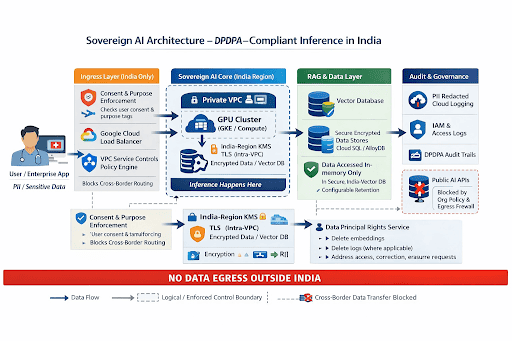
Sovereign AI is the practice of hosting and running Large Language Models (LLMs) entirely within your own infrastructure or a sovereign cloud located physically within India.
It moves away from renting intelligence and starts owning it. If you’re a CISO trying to stay compliant, here is the basic blueprint for your new tech stack:
- Open Source Foundation: Instead of closed APIs, organizations utilize open-source models (like Llama 3, Mistral, or Falcon) that can be inspected and controlled.
- Local Inference Layers: The models run on domestic GPU clusters. When a customer asks a banking chatbot about their balance, the query hits a server in Bengaluru, is processed in Bengaluru, and the answer is generated in Bengaluru.
- RAG with Guardrails: We use Retrieval-Augmented Generation (RAG) connected to your secure internal databases. The AI “reads” your data to answer questions, but that data is never trained into the public model; it stays in your volatile memory, behind your firewall.
The Healthcare & BFSI Edge
In a hospital setting, this is a game-changer. You can let doctors use AI to summarize notes because the “brain” of the AI lives right on your local server. No patient data gets sent into the cloud, so the DPDPA isn’t an issue.
For BFSI, it means fraud detection algorithms can analyze real-time transaction data without that sensitive financial metadata ever touching a third-party public cloud. It allows for “Privacy by Design,” satisfying the Data Protection Board’s strictest requirements.
The Readiness Gap
Most organizations believe they are ready because they have updated their privacy policies. However, their tech stack tells a different story. Many legacy applications still have hard-coded calls to external APIs or lack the “data tagging” required to filter what can and cannot leave the country.
Are your data flows actually sovereign?
Ask yourself: do you actually know where your data goes? If you can’t verify the physical location of the server running your AI inference, you’re essentially flying blind. As a trusted Google Cloud partner Mumbai, we specialize in auditing these data flows to bridge the gap between policy and technical execution.
Instead of waiting for an enforcement notice, it is time to get your compliance sorted now. Take a DPDPA Cloud Readiness Audit that maps out your current data flows and AI sovereignty. This will help you find exactly where your data might be crossing borders so you can fix it before it becomes a problem.
Don’t wait for the 2026 mandates to take effect. Reach out to Codelattice at askus@codelattice.com for a free consultation and secure your compliance roadmap today.